

You closed the account. The balance is zero. You assume you're done.
Then the underwriter asks for a bank-issued closed bank account letter. Or the auditor wants proof that the account wasn't merely inactive. Or an immigration case officer rejects a self-written explanation because it doesn't come from the bank. That’s where a common problem arises. A final statement often shows activity and ending balance, but it usually doesn’t confirm the exact closure date, whether the bank considers the relationship terminated, or whether any residual obligations remained.
That gap matters more than people expect. In practice, the problem isn't closing the account. It's proving, later, that the account was closed in a way a third party will accept.
Why You Need an Official Closed Bank Account Letter
The most common failure point is simple. A borrower sends the last monthly statement, highlights the zero balance, and assumes that will satisfy the lender. It often doesn't. Mortgage underwriting, audit testing, and visa reviews usually work on documentary standards, not common sense. If the bank hasn't confirmed closure on its own letterhead, the reviewer may treat the account as still open, or at least as unverified.
What a final statement usually fails to prove
A final statement can be useful, but it has limits. It normally shows balance and transactions through a statement period. It may not show the bank's official closure date. It may not confirm that pending debits were resolved. It may not state that the account is closed rather than dormant, frozen, restricted, or awaiting final processing.
That distinction becomes important when someone is trying to tie the account history to another document set. If you've ever had to explain deposits on a redacted bank statement used in a review file, you already know reviewers look for consistency across documents. A closed bank account letter gives them a clean endpoint.
A zero balance is an accounting fact. Closure is a legal and administrative fact. Third parties often require proof of both.
Closure is routine, not suspicious
Many people hesitate to request a closure letter because they think it makes the account closure look unusual. The opposite is true. A survey of bank customers found that only 5% closed accounts due to service issues, while the most common reasons were relocating (17%) and consolidating accounts (12%), making closures a routine part of financial administration rather than a sign of conflict, according to RMS Results' closed account survey.
That matters for business owners and finance teams. Accounts get closed because entities reorganize, treasury functions move, a company changes banks, or a personal account is no longer needed after a relocation or consolidation. None of that is remarkable. The paperwork becomes remarkable only when it’s missing.
Where the letter actually gets used
A proper closed bank account letter usually ends arguments before they start. It helps when:
- Lenders need hard proof that an old account won't be used as an undisclosed funding source or liability channel.
- Auditors need cut-off support to show the account no longer existed after a certain date.
- Immigration and visa reviewers need official documentation rather than self-prepared explanations.
- Internal finance teams need clean archives showing when an account relationship ended.
When stakes are high, "I closed it" isn't evidence. A bank-issued letter is.
Choosing the Right Closure Letter for Your Goal
Most online advice treats every closure request as the same document. That's a mistake. The wording that works for your own files is often too weak for a lender or regulator. The closed bank account letter should match the audience that will rely on it later.
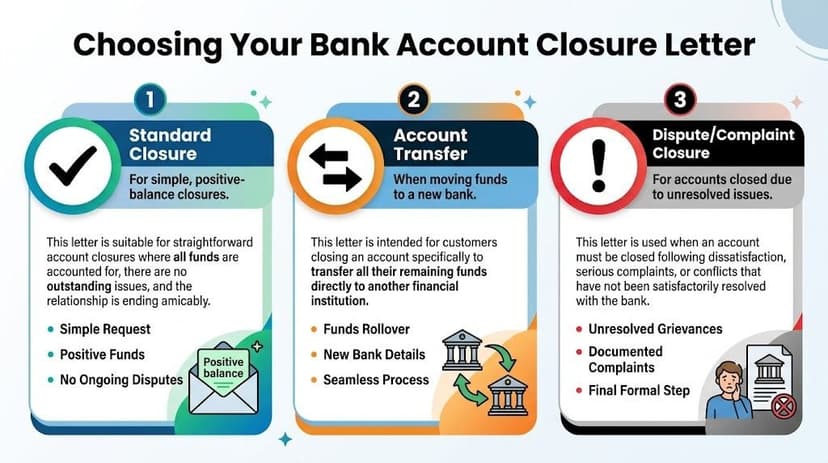
The three versions that matter
| Letter type | Best use | What it should accomplish |
|---|---|---|
| Personal request | Individual account closure and personal recordkeeping | Ask the bank to close the account and confirm the closure in writing |
| Business request | Company, nonprofit, or partnership account closure | Document authority, signer status, account details, and disbursement instructions |
| Third-party verification request | Mortgage, audit, immigration, or compliance review | Ask the bank to issue a formal confirmation letter addressed for verification use |
The weakest version is the casual email that says, “Please close my account and send me confirmation.” Banks may process the request, but the confirmation can be too thin to satisfy a third party. If your real goal is underwriting or audit support, your request has to say that clearly.
Why the third-party version matters most
Many firms lose time because a 2025 AICPA survey found that 68% of accounting firms encountered delays in client mortgage approvals due to missing official closure confirmations from legacy banks, with underwriters frequently rejecting self-drafted notices, as reported in this summary of closure letter requirements.
That figure tracks with what practitioners see. The issue usually isn't whether the account was closed. The issue is whether the evidence package meets someone else's standard. Underwriters, auditors, and government reviewers often want a bank letter that includes the closure date and confirms the account status in direct language.
If you're not sure what banking records generally reveal and what they don't, it helps to review what a bank statement shows. Statements and closure confirmations serve different purposes.
Match the request to the reviewer
Use this quick filter before you draft anything:
- For your own records: a standard personal closure letter is usually enough.
- For a business file: use a business version that identifies the entity, signer authority, and destination for remaining funds.
- For lending, audit, or immigration: request a bank-issued verification letter on letterhead, and state that a final statement alone isn't sufficient for the third party reviewing the file.
Practical rule: Draft for the person who will reject the document, not the person who will receive it first.
That one change fixes a lot of avoidable back-and-forth.
How to Draft Your Bank Account Closure Request Letter
A useful closed bank account letter request does three things well. It identifies the account without ambiguity. It gives the bank clear instructions on what to do with any remaining balance. It asks for written confirmation in language that fits the request's purpose.

What to include before you start writing
Before you draft, gather the exact legal name on the account, full account number or masked number as required by the bank, mailing address on file, and your preferred method for receiving any residual funds. For business accounts, confirm who is authorized to sign. For joint accounts, confirm whether both owners must sign.
If you’re working from statement images rather than portal text, review the account details carefully so the request matches the bank’s records exactly. A mismatch in account title or number creates delays that are hard to diagnose later. If you're extracting details from archived PDFs or scans, bank statement image review practices can help you avoid transcription errors before you send the letter.
Template for a personal account closure request
[Your Full Name]
[Your Address]
[City, State, ZIP]
[Date][Bank Name]
[Branch or Customer Service Address]Re: Request to close bank account [last four digits or full account number if required]
Dear Bank Representative,
Please close my bank account referenced above. If a remaining balance is on the account after all pending transactions have cleared, please remit the funds to me by [check mailed to the address above / electronic transfer as permitted by bank procedures].
Please provide written confirmation that the account has been closed, including the effective closure date and confirmation of the final balance at closure.
If additional forms or identification are required, please contact me at [phone] or [email].
Sincerely,
[Signature]
[Printed Name]
This version is suitable when the account holder mainly needs a clean written record. The key phrase is the request for the effective closure date. Without that, some confirmations come back too vague to use later.
Template for a business account closure request
[Business Legal Name]
[Business Address]
[City, State, ZIP]
[Date][Bank Name]
[Relationship Manager, Branch, or Treasury Services Address]Re: Business account closure request for [account name and account number]
Dear Bank Representative,
On behalf of [Business Legal Name], I request closure of the above-referenced account. I am an authorized signer for this account and have authority to submit this request.
Please process closure after all outstanding items have cleared and confirm in writing the official closure date, final account balance, and method used to remit any remaining funds.
Any remaining balance should be sent by [check payable to business legal name / transfer instructions if accepted by the bank].
Please address written confirmation to:
[Business Name or Department]
[Attention line if needed]
[Mailing Address or secure delivery instructions]Attached are supporting documents verifying signer authority and business identity.
Sincerely,
[Authorized Signature]
[Printed Name and Title]
This version does more than ask. It establishes authority. That matters because business account closures often stall when the bank isn't satisfied that the signer has current authority.
Template for third-party verification use
Some situations call for stronger wording. This is the version I’d use when the actual audience is a lender, auditor, or immigration reviewer.
[Your Name or Business Name]
[Address]
[Date][Bank Name]
[Branch Manager or Customer Support Department]Re: Request for official bank confirmation of account closure
Dear Bank Representative,
I request written confirmation on bank letterhead that account [account number or masked account number] has been closed.
Please include in the confirmation letter:
- The name of the account holder
- The account number, whether full or masked according to bank policy
- The effective date the account was closed
- Confirmation that the account balance was zero at closure, if applicable
- Confirmation that the account is closed and no longer active
This confirmation is required for third-party verification in connection with [mortgage underwriting / audit support / immigration documentation / loan application].
If notarization or branch stamp is available under bank policy, please include it.
Thank you.
Sincerely,
[Signature]
[Printed Name]
The value of this version is precision. It tells the bank what the final letter must contain. If you don't specify those items, you may get a generic note that says little more than “per your request, the account was closed.”
A short walkthrough can help if you're helping a client draft the request:
Phrases that work and phrases that don't
What works:
- “Please provide written confirmation on bank letterhead.”
- “Please include the effective closure date.”
- “Please confirm that the account is closed and no longer active.”
- “This letter is required for third-party verification.”
What doesn't work:
- “Please send something showing I closed it.”
- “My last statement should be enough.”
- “Can you email me a note?”
The bank can only respond clearly if your request is clear. Vague requests produce vague confirmations.
Gathering Documents and Verifying the Closure
Sending the letter isn't the finish line. The file isn't complete until you have proof that the bank processed the request and that the account status changed the way you intended.
What to send with the request
Most banks will ask for supporting documentation, especially for mailed or branch-submitted requests. The exact list varies, but the practical package usually includes:
- Government-issued identification for individual accounts.
- A recent statement or account reference page to help the bank match the request accurately.
- Signer authority documents for business accounts, such as a corporate resolution, secretary certificate, or internal authorization document, depending on the institution’s process.
- Clear disbursement instructions for any residual funds.
- Joint account signatures if the bank requires all owners to authorize closure.
If your team is standardizing closure files, it helps to convert the final statement into a structured archive format alongside the request and confirmation. For firms that keep XML-based workpapers or integration records, PDF-to-XML conversion workflows make the final statement easier to tie back to the closure package.
What to verify after submission
The biggest mistake is changing autopays, books, or audit status before written confirmation arrives. Approximately 30-40% of organizations create serious reconciliation gaps by failing to obtain written closure confirmation before updating automatic payment arrangements, according to this documentation guidance on closure confirmation standards.
That happens because an account can be in transition. The customer thinks it's closed. The bank may still be clearing an item, waiting on an internal review, or preparing a residual balance check.
Use this follow-up checklist:
- Confirm receipt of the request through the branch, secure message center, or customer support channel.
- Ask whether the account is pending closure or fully closed. Those are not the same status.
- Request the bank-issued confirmation letter if it doesn't arrive automatically.
- Review the final letter for key details including account holder name, closure date, and status language.
- Only then update downstream records such as autopays, accounting ledgers, lender files, and internal checklists.
What the final confirmation should say
A useful confirmation should answer basic review questions without explanation from you. It should identify the account, state that the account is closed, and show the closure date. If relevant, it should confirm the final balance or indicate how the remaining balance was remitted.
If any of that is missing, ask for a corrected letter immediately. Fixing it later is much harder once the file has already been submitted to an auditor or lender.
Navigating Common Pitfalls and Complex Closures
The standard advice online assumes every closure is voluntary, clean, and uncomplicated. That's not how many real files look. Joint ownership, overdrawn balances, dormant status, and bank-initiated shutdowns all change what kind of closed bank account letter you need.

Joint accounts and signer problems
Joint accounts fail for procedural reasons more often than substantive ones. One account owner thinks a single signature is enough. The bank requires both. Or one owner changed address years ago and never updated identification records.
For those files, don't start with a generic closure request. Start by confirming the bank’s signature rules and ID requirements. If one owner cannot appear in person, ask the bank what substitute process it accepts. The closure letter request should then match that process exactly.
Negative balances and unresolved items
An account with a negative balance is not a normal closure. It’s a settlement issue first. The bank may refuse to issue a clean confirmation until the shortage, fee balance, returned item, or pending debit problem is resolved.
In those cases, the right request is often not “close my account immediately.” It’s “confirm the amount required to resolve the account, then issue written confirmation once the account is closed.” That wording avoids a common trap where the customer believes the account is gone, but the bank has merely restricted it while the negative balance remains open.
If money is still owed, ask for a payoff path first and a closure confirmation second.
Dormant and unilaterally closed accounts
Dormant accounts create a different problem. The customer may not have initiated closure at all. The bank may have restricted or closed the account due to inactivity, policy, or administrative handling. In those files, the letter you need is less about your request and more about the bank’s status confirmation.
Ask the bank to state whether the account is dormant, closed, or transferred to unclaimed property handling under its process. That distinction affects both accounting treatment and any later recovery work.
Bank-initiated closures and compliance sensitivity
Some closures are driven by compliance reviews, not customer choice. This isn't rare in regulated industries or in accounts with unusual transaction patterns. U.S. banks filed 4.6 million Suspicious Activity Reports in one year, and examiners often expect accounts with multiple SARs to be closed, as explained by the Bank Policy Institute's discussion of account closure pressure.
For CPAs and advisors, that context matters because clients often want a reason the bank will not provide in detail. In many bank-initiated closures, the institution will give limited explanation. The practical move is to request a neutral confirmation of closure date, current status, and disposition of funds rather than pushing for a detailed narrative the bank may refuse to issue.
What usually works in messy files
Here’s the assumption I’d challenge: many people think persistence alone solves difficult closures. It doesn't. Precision solves them.
Use a targeted request based on the problem in front of you:
- Joint ownership issue: confirm signature and ID requirements first.
- Negative balance: resolve the shortage before demanding closure proof.
- Dormant account: request status classification and funds disposition.
- Bank-initiated closure: ask for neutral factual confirmation, not an explanation of internal compliance decisions.
That approach gets better results than sending the same template into every situation.
A CPA's Guide to Reconciling Closed Accounts
For accounting teams, a closed bank account letter is not just customer service paperwork. It’s part of the close process, part of the audit trail, and part of client offboarding when banking relationships change.
Build the closure into the reconciliation workflow
The cleanest files start before the closure request goes out. Reconcile the account fully. Review uncleared checks, pending ACH items, bank fees, transfers in transit, and any statement-end timing issues. Then compare that result to the disbursement instructions in the closure request.
This is the same discipline used in reconciling a bank account, but with a harder endpoint. You are not just proving a month-end number. You are documenting the termination of the account itself.
What I’d put on a firm checklist
A practical firm checklist should include:
- Final statement obtained and saved in the client file.
- Outstanding transactions reviewed so the closure request isn’t sent too early.
- Closure request drafted for the actual use case, whether internal records, lender package, or audit support.
- Signer authority confirmed for entity accounts.
- Written bank confirmation received and reviewed for closure date and account status.
- Autopays and linked transfers updated only after confirmation.
- Archive package completed with final statement, request letter, confirmation letter, and internal notes.
Working rule for firms: If the confirmation letter isn't in the file, the closure isn't finished from an audit standpoint.
Archive for the next reviewer, not the current one
At this stage, many otherwise strong files break down. The controller knows the account is closed. The preparer remembers the branch call. None of that helps six months later when a lender, auditor, or tax reviewer asks for support.
Keep the closure request, the final statement, and the bank’s confirmation together in one folder or document set. Name the files so someone else can understand them without calling the original preparer. If the account fed a bookkeeping platform, tie the closure record to the final reconciliation memo.
That discipline pays off when a client refinances, gets audited, applies for immigration benefits, or needs to explain old transfers. The strongest closure package is the one that answers the reviewer’s question before they ask a follow-up.
Frequently Asked Questions About Closed Bank Account Letters
How long does it take to receive a closure letter
It depends on the bank and the delivery channel. Some institutions post confirmations to secure online banking messages. Others mail them or require branch pickup. If timing matters, ask the bank how it delivers closure confirmations before you submit the request.
What if the bank refuses to provide a formal letter
Ask for the most official alternative the bank will issue, such as a secure message, branch-stamped account status notice, or account services confirmation generated through its internal system. Then ask whether the bank can include the closure date and account status in that format. If the document will be used outside your country, you may also need accurate financial document translation so the receiving authority can evaluate it properly.
Is this different for credit card accounts
Yes. Credit card closures often require different wording because the reviewer may care about the line being terminated, the payoff status, or whether the account can still be reactivated. Don’t assume a bank deposit account template will work for a card issuer.
What records should I keep
Keep the request you sent, the final statement, the bank’s closure confirmation, and any communication showing how residual funds were handled. For business clients, also keep the authority document that supported the request.
Can I use a self-written letter as proof
Usually only as a starting point. A self-written letter can explain your request, but it rarely substitutes for a bank-issued confirmation when a lender, auditor, or government reviewer wants independent proof.
If you're cleaning up final statements, reconciling the last month of activity, or organizing closure support for multiple clients, ConvertBankToExcel helps turn bank PDFs into structured files your team can review, reconcile, and archive without manual rekeying.